Showing posts with label noir. Show all posts

Sunday, June 6, 2010

Movies! Blue Velvet


For some reason known only to my always obsessive brain, I often watch every single movie a director has made in a crazy Netflix spree. That's what I've been doing with David Lynch, and I have to say that Blue Velvet is my favorite of his movies. Starring Lynch regular Kyle MacLachlan, Isabella Rossellini, Laura Dern, the utterly fab Dean Stockwell, and the scarier than hell Dennis Hopper, this movie is a dark, surreal mystery with a robin fetish. Well, that's the least of its fetishes, to be honest.
Young Jeffrey returns home from college to help out in the family hardware store after his father gets sick, and finds a severed human ear in a field. After turning the ear into the police, Jeffrey becomes involved with (a) the police chief's bright young daughter, (b) the disturbed and haunted wife of the man whose ear was severed, (c) the amyl nitrate huffing psycho who cut off the ear, (d) the dark and violent convoluted mystery of the reason for the severed ear, or (e) all of the above. If you answered e, you are correcto-mundo.
Lynch has called it "a film about things that are hidden--within a small city and within people." Once again, it explores Lynch's fascination with the darkness that lies beneath the apparent idyllic surface of small town America. It has sex, violence and lots of close ups of bugs. I have to say my favorite scene is also, for me at least, the strangest in the movie, where the Man in the Yellow Suit is standing, shot and bleeding and apparently dead, upright in a seedy apartment, as the Man Who Got His Ear Cut Off (aka Don) kneels in front of him with his head all hacked up and bandaged. It is as odd as any surrealist painting, and an image that will stick with me forever. Yep, it's a feel good kind of movie, further enhanced by Dean Stockwell in freaky makeup singing "In Dreams" with a shop light for a microphone, and Dennis Hopper going absolutely psycho in every single scene. Man, Dennis was amazing.
Interestingly, Robert Ebert absolutely hated the movie, and thought Lynch degraded Isabella Rossellini to an unacceptable point. Some of her scenes are certainly difficult to watch, but there's an artistry to the film that shines beyond the darkness. Lynch is a genius, and I think this film may be his neo-noir masterpiece.

Tuesday, November 17, 2009

Noir! Gilda and The Lady from Shanghai

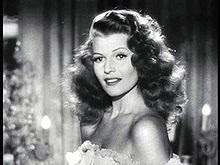
Oh, let's take a moment and talk about the unearthly, amazing beauty of Rita Hayworth. She was the daughter of a star flamenco dancer and a Ziegfield girl. She appeared in 61 movies. Fred Astaire said she was the best dancer he ever worked with. She was married to Orson Welles and Prince Aly Khan. Her picture was on the first nuclear bomb tested after World War II. She was a pin up star, a glamour girl, extraordinarily smart and sexy as all hell. When you hear the phrase, Golden Age of Hollywood Screen Goddess, you think of Rita Hayworth.


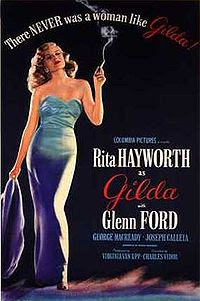
Which brings us nicely to Rita's best known movie, Gilda (1946). Glenn Ford is Johnny Farrel, a small time hustler who falls in with a sinister casino owner, Balin Mundson, in Argentina, and becomes the manager of the establishment. The casino owner, icily portrayed by George Macready, brings his new wife home after a trip, none other than nightclub singer Gilda, the stunning Rita Hayworth. It seems that Gilda and Johnny were a couple at one time, and that certainly complicates things when Mundson asks Johnny to look after his new bride. Throw in some Nazis, an illegal tungsten cartel, and Gilda's femme fatale "clothed striptease," and you get a racy, perfect little noir movie. This one will surprise you, with its hints of female wantonness, and its ability to make Glenn Ford even a little bit lusty. Also, the ending is completely unexpected in terms of film noir.

The Lady from Shanghai was shot only a year later, but we get an entirely different Rita in this movie. The movie co-starred and was directed by Hayworth's then estranged husband, Orson Welles. Welles cut and bleached Rita's trademark long red hair, much to the chagrin of studio heads. The plot is extremely convoluted and utterly noirish. Suffice to say, Rita is the blonde femme fatale with a husband, Welles is the pursurer, there's a boat, planned crimes that go awry, and a wonderfully funny criminal trial. See the movie for the Hall of Mirrors ending. Surreal, genius, and about fifty years before its time, I have never seen anything quite like it. As usual, the studio chopped about an hour from Welles' final cut before release. Poor Welles, the guy was a genius who was never allowed to completely express himself. Also, there were apparently odd links between this film and the infamous Black Dahlia murders, including shared locations and other facts that were cut from the final film.

Rita Hayworth. . . one of the most gorgeous women ever, sexier than her times would allow her to be.

Tuesday, November 10, 2009

Thursday, October 1, 2009

Noir! The Big Clock


Now, this is some noir, people! If you like black and white movies, again with a little bit of grit to them, you will love The Big Clock, released in 1948. I was so surprised by how great it was. First off, it has the amazing Ray Milland in the lead, with quirky Charles Laughton as the heavy, and his real life wife, Elsa Lanchester, as the wacky modern artist. Elsa was the Bride of Frankenstein, and she has the most unusual voice and is such a joy to watch. She fills the screen with warmth, and I may now have to see every movie she was ever in.
Ray Milland is an editor for a true crime magazine, run by the unctuous Laughton, in a Randolph Hearst-like role. A crime occurs (yes, it involves a dame, alcohol, and a clock), and Milland must use all of his creative wiles to solve the crime to avoid being convicted himself. Suspense, twists and turns, and even Maureen O'Sullivan, it's a noir cornucopia.
The movie feels a bit like a Hitchcock film, with its "wrong man suspected" theme and its taut thrills. It also has quite a bit of black humor and comedy. Laughton here reminds me a bit of Orson Welles in A Touch of Evil, and the last half of the film, with Milland going to great lengths to expose the true killer, is just delightful. Man, it has held up well, considering it's over sixty years old. Give it a go.
Great quote from The Big Clock: "Isn't it a pity... the wrong people always have money. "

Monday, September 21, 2009

Noir! The Naked City


"There are eight million stories in the naked city. . ."
What a strange little movie this is. It was released in 1948, and came in at the end of film noir. What it reminds me most of is Law & Order, of all things. Shot completely on location in New York City, The Naked City follows the police investigation of a young blonde model. There's a seasoned older cop, a younger green cop. There's surprisingly modern crime scene investigation. It gets a bit slow and tedious through the middle, but then I would imagine that police detective work is mostly comprised of slow and tedious work.
What makes this movie interesting is how New York City becomes a character in the film, because of the way it's shot and the use of so many extras providing "local color." The cinematography is documentary-like and fabulous. A great portrait of a complicated city in the late 1940's.
The other thing I really loved about the movie is the voice-over narration. Sometimes, that can kill the momentum of a plot in a film, but here that omniscient voices adds a certain witty and wise commentary when the going gets a little boring.
Do you like gritty, realistic police drama? Do you like Law & Order? Then I highly recommend this to you. Not so noir, but a wonderful time capsule view of New York sixty years ago. Plus, they call women "dames" quite a bit. Why does that make me so happy? I want to be a dame!

Sunday, September 6, 2009

Noir! Nighmare Alley and Leave Her to Heaven

Nightmare Alley (1947) stars Tyrone Power as a con man who turns into a highly successful carnie mentalist by tricking his way into a mind reading code. From there, he hooks up with an amoral female psychiatrist to bilk the wealthy out of large sums of money by revealing their unknown secrets, only spoken about in therapy. It's a grim, fatalistic little movie, full of seediness and alcoholism, and a deep, dark, inescapable Fate. Yes, Fate, with a capital F. Powers really is quite good, and Joan Blondell is magnificent as the fading sideshow mystic. But the best performance of the film goes to Helen Walker as the psychotherapist who rolls the biggest con of all. Hardly a sunny movie, rather wonderfully black noir, and worth a watch for the realistic carnival atmosphere, if nothing else. Plus, you find that you're always only several steps away from becoming the Geek. Good to remember.

Now, Leave Her to Heaven. Wow. The title is taken from Hamlet, speaking about his mother: "leave her to heaven, and to those thorns that in her bosom lodge to prick and sting her." Gene Tierney is fantastic as the dangerously jealous femme fatale of a wife with wonderful taste in clothing and sunglasses. She will do anything to have her husband to herself, and I mean anything. I'm usually not a fan of Tierney. She was completely beautiful, with her angelic face, but often comes off as flat onscreen. Here, that quality works for her, as it did for Nicole Kidman in To Die For. That feeling that something is missing from their emotional makeup that can cause a romantic role to fall flat works so well when the role is somewhat sociopathic.
My only question would be this: Can a movie in such lush Technicolor actually be considered noir? It's beautifully shot and full of criminal twists and turns, but I'm not sure it's noir. Wonderful, yes. As an addition, keep an eye out for a very young Vincent Price as a prosecuting attorney/spurned lover. So good, I watched it twice.


Monday, August 31, 2009

Noir! Murder, My Sweet and Where the Sidewalk Ends


Both of these are great films noir, or film noirs, however you'd like to say it. They're both great. If you like old black and white movies, gritty and full of crime, you'll enjoy either of these.

Murder, My Sweet is an adaptation of Raymond Chandler's novel, Farewell, My Lovely, with Dick Powell as detective Phillip Marlowe. The movie takes place almost entirely at night in L.A., which gives it this strange, dreamy quality that borders on nightmare at times. The dialogue sounds a bit dated sometimes, but you get blackmail, a femme fatale, and some wonderful costumes, not to mention a very strange drug-enduced hallucination sequence. I'm not a big fan of Dick Powell, and thought he was kind of an odd choice to play Marlowe. Let me know what you think.

Where the Sidewalk Ends has nothing at all to do with the children's poetry book by Shel Silverstein. I'd never heard of this movie, but it is a wonderful little thing, with a great noir hero/anti-hero in Dana Andrews as the hard boiled cop with a troubled past. His face is just so great under the brim of a fedora. Lots of smoking, drinking, and punching in the face. Co-starring the lovely but rather flat Gene Tierney, with a cameo by her husband of the time, Oleg Cassini as a clothing designer (what a stretch!). Whereas Murder, My Sweet is quintessentially Los Angeles, Where the Sidewalk Ends is utterly New York. It's grim, murky and beautifully directed by Otto Preminger. Of the two movies, I prefer this one.
As far as the costumes, both films offer up great fashion. I always wear a sequin-encrusted full length evening gown to go see my favorite private eye, don't you? And it's always two o'clock in the morning. Plus, you can see where so many of the standard plot points in movies today got their start.
"You look all bunged up like a barrelhouse vag." You just don't get lines like that anymore.

Tuesday, August 25, 2009

Touch of Evil


I watched Touch of Evil tonight, while I was making jewelry and trying to figure out the whole Twitter thing. I'd forgotten how sinister and gritty and scary it is. Yes, it has Charlton Heston as a Hispanic, and that is scary enough. It has car bombs, narcotics, police corruption and perversity. It has Marlene Dietrich as an aging gypsy, Orson Welles as a portly police man and even Zsa Zsa Gabor as a show girl. It has this great quote: "Your future is all used up." Janet Leigh is kidnapped by a gang. Heck, it even has Dennis Weaver for comic effect as the night man at the seedy motel. It has the most gorgeous camera work, including that incredibly long opening tracking shot that just goes on and on and on for about four minutes.


I think it's Orson Welles' masterpiece. He wrote, directed, and co-starred in the movie. I can't imagine what audiences thought when they saw it in 1958, although I think the version seen then was a bit different, and a little tamer, than this restored version on DVD. Apparently, Universal edited and reshot parts of it without Welles' permission. His actual cut of the movie no longer exists, and you have to wonder what got tossed into the trash bin. . .
It's one of those movies that doesn't seem all that dated today. Wow. You know, the man only ever finished about a dozen movies. This is one of the best of all time. Now, THAT'S noir! If you like this sort of thing, and you haven't seen it, give it a go. Very good stuff.